Speech for Aurich from Dr. Werner Knurr (23.10.2017)
I am very happy to be here. Thank you for inviting me to return to the place of my birth and for bestowing this honor upon me and my family.
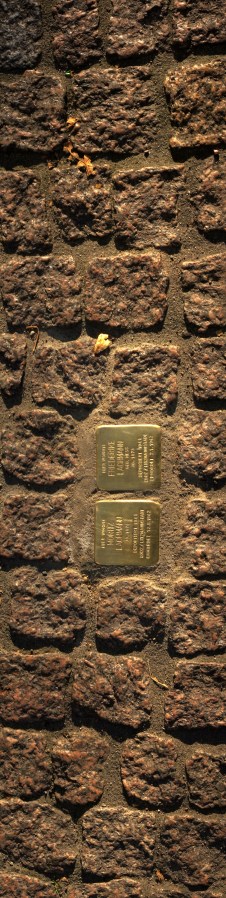
Many thanks to Frau Irmtraud Hausmann for donating my stolperstein, and to Christiane Meissner for her encouragement and profound understanding.
My thanks to Gunther and Elfriede for everything over all the years of correspondence. I finally get to meet you and Beauly and Enya.
Lastly, thank you to my friends, Tom and Jeanette Eilers, for accompanying Goldie and me on this trip and for participating in this momentous occasion.
I apologize for my weak and slow German and beg your indulgence. It has not been an easy task to condense my family’s history into twenty minutes. For some of you here today, this story may be similar to what you or your families experienced.
The year was 1963. I was a Captain in the United States Air Force. I drove up the Rhine to Aurich. I did not wear my uniform, nor did I have my nametag, nor did I have a reservation at the Hotel Piquerhof. As I picked up the pen to sign the registry, a man tapped me on the shoulder and said in German, ”Excuse me, but are you Hermann Knurr?” I responded in German, ”No, I am Werner, son of Erich. Hermann is my uncle.” Imagine my schock! After 25 years he, the owner of the hotel, recognized a Knurr. All three men had been schoolmates. I resembled my uncle more than I did my father.
Later, I toured the Knurr store, which had been bought by the Diermann’s and had become a fruit and vegetable store (obst geschaft). On the third floor, to my great surprise, my Opa Lippmann’s clothes racks and hangers were still there! I broke down and cried.That was my first return to Aurich.
The next was 34 years later in1977, to show my four children and my beautiful fiancé`, Goldie, where I was born, my roots, as it were.
Now let us go back in time to the year 1938, the year of our exodus. My dear Mother, Melanie, of blessed memory, had the foresight to get our passports a year in advance. How prophetic! But she was prophetic in more than one way. As so many Jewish men did, my father wanted to come to America first to find a job and housing and then send for us later. My Mother declared, “ If you leave us, you will never see us again!” She saw the handwriting on the wall. My Opa Lippmann refused to get his passport, saying, “They won’t bother an old man like me!” We left Aurich after a friendly policeman warned my father that he would be arrested shortly.
There were problems with our visas. At this time, I was almost three years old. Papa had to travel back to Germany from Holland and go back and forth between Hannover and Hamburg in an effort to get Belgian visas. He finally secured visas to go to France. In the meantime, awaiting Papa’s return, Mama and I stayed overnight in a train station and in a Jewish stranger’s home. We had to pass through heavily armed checkpoints when we crossed the Dutch border. Quite stressful!
After a few days in Paris, we travelled to Le Havre where we boarded the SS Manhattan and travelled the seven days across the Atlantic to arrive at the Port of New York. Since I was so young, I remember very little of the trip, except that we lost a washcloth overboard and mother and I were quite seasick.
We travelled first class because we could take very little money with us, just DM100 ($25 per adult and nothing for me). Prior to leaving, Papa also went to the poor section of town in Aurich and gave much of his money away. Fortunately, we were able to ship our furniture in advance of our departure.
Imagine, if you can, saying goodbye to your father, knowing you would never see him again, to your country, to your Fatherland, to your mother tongue, to your synagogue, to your store, to everything and everyone in the world that meant anything and everything to you. I don’t think I could or would do it. I would not have had the courage or the strength.
When we first saw the Statue of Liberty, mama and papa wept. Upon disembarking we expected to see cowboys and Indians, and were frightened by the first black person we saw! We arrived New York on October27, 1938, two weeks before Kristallnacht.
The immigration official asked my father if he would like to change our name? Father responded,” It is already one syllable. What would you have me do to it?” This caused my father to laugh rather heartily.
After a few days, we took the train to Baton Rouge, Louisiana. Lea, Papa’s sister, and her husband, Erich Sternberg had arrived about two years earlier and had already purchased a department store. Sternberg was our former competitor in Aurich. It was they and Dr. Melville Sternberg who signed affidavits of support, without which, we could not have entered the United States.
Papa went to work in the stockroom for his brother-in-law, Sternberg. They quarreled, and he fired Papa.
Prior to emigrating, knowing that he might encounter difficulties in obtaining employment and coupled with not knowing English, Papa apprenticed for six weeks as a chiropodist (podiatrist as it is known today). He opened an office in Louisiana and was promptly arrested by the police for practicing without a license. Since he didn’t know the language he couldn’t take the examination. He then checked the directory for states that did not require an examination to obtain a license. There were three. The closest was Alabama. He took a train to Montgomery and he liked the orthodox Jewish congregation there. And that is where we settled.
Papa practiced podiatry for a year or so, but couldn’t make a living, charging only a dollar or two for a visit. Incidentally, he had the best and only electrical instruments in town, causing much jealousy among his colleagues.
Papa was offered money (charity) from the Jewish Federation, which he declined, being too proud to accept, exclaiming, “Just get me a job!”
He worked the midnight shift 12 to 8 in a junk yard (scrap metal) for $13 a week, from which he sent $1or $2 every week to the Swiss Embassy in Havana, Cuba, for Opa Lippmann who was still in Germany. We doubt that he ever received it.
Life was hard. Papa was 38 years old and Mama was 28. On Shabbat he was only able to bring Mama 10 cents lemon drops, instead of expensive bon-bons as in Aurich. It was a touching moment.
To save money, we walked to town instead of paying 5 cents bus fare each, and we divided a 5 cents Hershey chocolate bar three ways. Indeed we were so very poor!
Papa had several jobs, before getting a position at Solomon Brothers Wholesale Dry Goods business, where he worked for four years. On Saturdays , our Sabbath, he worked in a shoe store for $5 a day.
In 1945 my father met Leo Glick, an illiterate butcher who had some money. Papa had the business experience. So they went into business together: Glick and Knurr General Merchandise, in the black section of town. We put Glick’s name first as it means “luck”. The store sold everything: groceries, fruit, vegetables, meat, hardware, patent medicines, beer and clothing and was open 7 days a week, 12 hours a day, 14 on Saturday and 6 on Sunday. After a few years Mr. Glick died and Papa bought out his widow. We hoped luck, “glick”, would stay with us.
Not until 1953, during my first year at the University of Alabama, were we able to buy a house. It had to be heavily mortgaged. Our first home in America! I remember vividly how emotional Papa got when he put the deed to the house in the store safe, for he had already suffered his first heart attack in 1950 at age 50, and he was grateful to God for having allowed him to reach that day.
Papa always wore a suit and tie to work, always the gentleman. Mama worked beside him everyday. To her immense credit, when she was in her forties, she learned to drive a car. Papa worked at the store every day until he died in 1964 at the age of 63. Mama had a severe stroke about two years following Papa’s death and lived in a nursing home for13 years, dying at age of 67. In my opinion, the severe stress of immigration, coupled with some bad genes, contributed to their early demise.
Papa tried to join the United States Army during WW11, but was rejected because he was too old and he had a child. But the FBI sought him out for topographical information regarding the Lowlands for a possible invasion site for D-Day. Other sites for consideration were Normandy, Pas de Calais and LeHavre. In this way he was serving his newly adopted country. The FBI also requested the labels from his German made suits, to be sewn into the suits of American spies.
I had to attend kindergarten for three years until age seven to learn English, which I brought home to my parents. After some time Mother spoke a perfect, if slightly, accented English. But, Father spoke a broken English laced with a lot of profanity!
In 1943, my sister, Evelyn Gerta was born, while Papa and I were at the movies watching “Casablanca” with Humphrey Bogart and Ingrid Bergman! How embarrassing!
A most comical event occurred when Papa received a telegram from Goebbels demanding he return to Germany to serve his fatherland. He had been drafted into the German army in 1918 and was marching to the front when the armistice was declared. I guess Knurr is not a typical Jewish name. Anyway, Father crumpled up the telegram and threw it in the fireplace. I sure wish I had kept that piece of paper. I could have retired much earlier!
We became proud American citizens in1944! That year was the first time I saw Father cry. He had received a telegram from the Red Cross informing him that his father, Lippmann, had died in 1942, a scene indelibly imprinted in my mind’s eye.
As a child and then as an adolescent, I had nightmares in which I was looking down on a railroad station filled with storm troopers. This recurring nightmare and what Papa always said, “Keep your passport in order, a suitcase packed, and some travelling money ready, for a Holocaust could happen again anywhere you are!” stayed with me and colored the rest of my life.
Throughout our darkest and most difficult days, Werner was going to go to the university. My getting a good education was of paramount importance to my parents. I attended public schools in Alabama for my entire education, becoming a Doctor of Medicine in 1960.
In 1961 on the day I finished my internship, as the Berlin Wall was erected, I was drafted into the United States Air Force as a Captain. What a colossal irony when you consider our history, having been forced to flee Germany and then conscripted to protect Berlin from the Soviets! I served my country gladly, gratefully and proudly, repaying a mighty debt – a “noblesse oblige”!
After my discharge from the air force, I became a radiologist and practiced first in Pennsylvania and then in Florida, retiring at the age of 70. Goldie and I moved to Aspen, Colorado and then to the mountains of the Roaring Fork Valley.
I had four children: the one named Eric Lippman Knurr after my father and grandfather, died at age 49. And thank you Elfriede for that beautiful poem that you sent me upon learning of the death of my son, Eric.
Goldie has two children, one of whom served in the Israeli Defense Forces. All of our children and grandchildren are well educated, a manifestation of the influence of our culture and our heritage.
We had seven grandchildren, one of whom, Joshua, died at 10 months. My sister Evelyn died at age 70.
We are and always were a proud family whose motto is “Klein, Fein und Rein”. Over the years I have spoken to many different groups of different ages about my family’s wartime experiences. I always end with showing my citizenship papers of which I remain so very proud.
Today, Goldie and I are active in the Jewish community in Aspen and especially the Temple where Goldie serves on the board and I occasionally substitute as rabbi and cantor. At my age and level of involvement, I am often considered the patriarch of the congregation. We both teach Hebrew and help prepare children for their Bar and Bat Mitzvahs. We have also taught English, as a second language, to Latinos.
As you might well imagine, we are active in the organizations that oppose mass deportations.
Finally, I have two very short songs for you that my dear Mother taught me when I was in kindergarten. If you know them, please join in with me.
May G-d bless all of you here today and may G-d bless the United States of America.
 Stolpersteine Aurich